
Updated November 2026
The short version
- Most older fire alarm panels report through a DACT that dials out over POTS lines.
- NFPA 72 now expects a DACT to pair one phone line with another means, such as cellular, radio or IP, or to use a performance-based path with no phone line at all.
- If a required fire alarm is out of service for more than 4 hours in 24, NFPA 101 calls for the authority having jurisdiction to be notified and a fire watch or evacuation.
- Everything here is subject to national and local codes and ordinances, and the fire marshal or local authority decides what is accepted for your building. This guide is not legal advice.
How a fire alarm panel reports to the monitoring center
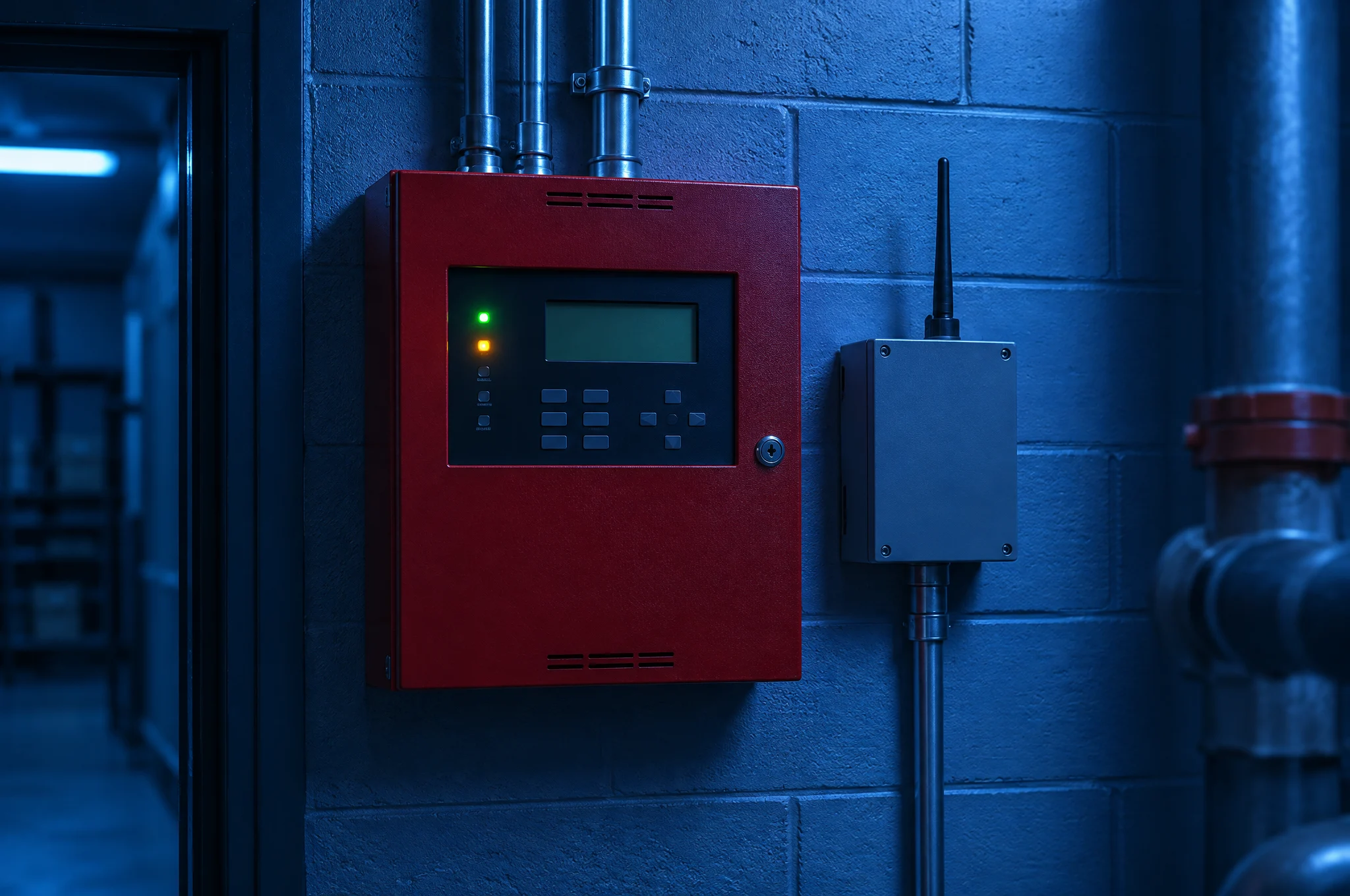
When a smoke detector, pull station or sprinkler flow switch is triggered, the fire alarm control panel sends a signal to a supervising station, often called the monitoring center or central station. Operators there notify the fire department and the people on your call list.
For decades, that signal went through a digital alarm communicator transmitter (DACT). The DACT seizes a phone line, dials a receiver at the monitoring center and sends coded signals. State fire officials note that DACTs relied on two standard POTS lines, and that these lines have become either unavailable or extremely expensive.
What NFPA 72 allows instead of two phone lines
NFPA 72, the National Fire Alarm and Signaling Code, sets how signals travel to the supervising station. Newer editions moved away from two copper lines and toward a performance-based approach.
- DACT with one POTS line plus another path
- How it works: The panel dials over one phone line and uses a second, different path as backup.
- What to know: The second path can be cellular, radio or IP. A second phone line is allowed only where none of those is available and the authority having jurisdiction approves it.
- Cellular communicator
- How it works: Sends alarm signals over a cellular network, with no phone line.
- What to know: Can replace one or both phone lines. Some setups use two cellular paths or cellular plus IP.
- IP communicator
- How it works: Sends alarm signals over the building's internet connection.
- What to know: Often paired with cellular so the panel has two independent paths.
- Radio
- How it works: Sends signals over a one-way private radio or two-way radio network.
- What to know: Needs a radio network that reaches your monitoring center.
Whatever the method, NFPA 72 requires the communication path to be monitored. A single path must be checked at least every 60 minutes; with multiple paths, each must be checked at least every 6 hours, and a failure is reported to the monitoring center. The equipment must be listed, and the fire marshal decides what is accepted.
What a cellular fire alarm communicator does
A cellular fire alarm communicator connects to the panel and sends its alarm, trouble and supervisory signals over a cellular network instead of a copper phone line. It can work alongside the panel's existing DACT, taking the place of the second phone line, or replace both lines.
State fire officials caution that VoIP is not recommended for transmitting fire alarm signals, because VoIP equipment compresses the alarm data. That is why fire alarm panels usually move to cellular, radio or IP communicators rather than a VoIP phone line. Your alarm vendor and monitoring company confirm which communicator suits your panel.
What happens when the POTS lines go
Carriers are retiring copper, and FCC orders adopted in March 2025 make it easier for them to discontinue legacy phone services. When a fire alarm panel's POTS line goes dead, the panel can no longer reach the monitoring center on that path, and the failure shows up as trouble at the panel and the monitoring center. If no working path remains, the building is no longer monitored.
For a building, a lost fire alarm phone line can mean:
- The building placed on fire watch, with the cost of staff on patrol until monitoring is restored
- Failed or flagged fire inspections
- A certificate of occupancy put at risk
Why a fire watch is costly
NFPA 101, the Life Safety Code, says that when a required fire alarm system is out of service for more than 4 hours in a 24-hour period, the authority having jurisdiction must be notified, and the building must be evacuated or an approved fire watch provided until the system is back in service.
A fire watch is not a quick check. Under published fire watch procedures, such as ASHE's, it typically means:
- Dedicated people, trained in fire prevention, assigned beyond normal staffing
- Continuous patrols of every affected area, documented as they go
- A fire extinguisher on hand and a way to notify the fire department and occupants
- A log kept for the authority having jurisdiction
Those staff hours run for as long as the system is out of service, day and night. Your fire marshal decides what your building would need. Replacing a panel's POTS lines before they fail keeps the building from needing a fire watch at all.
How to replace a fire alarm phone line
Fire alarm changes are life-safety work. Plan each panel with its vendor and the local authority before any line is canceled:
- List every panel and the POTS lines it uses, from phone bills and a look at each panel.
- Confirm with your fire alarm vendor and monitoring company which communication method and equipment the panel needs.
- Check with the fire marshal or local authority whether a permit, plan review or acceptance test is required.
- Install the new path with battery backup, and send test signals to the monitoring center over it.
- Cancel the POTS line only after the panel passes testing, and keep the records for your next inspection.
How 5x5 Telecom can help
5x5 finds every POTS line in your building, including each fire alarm panel's lines, and confirms what each system needs with your vendors and local inspector. We replace each line with the right combination of cellular, LTE, 5G, internet connections and VoIP adapters, with battery backup, and work with your existing monitoring company, so you do not need to change.
Every panel is tested with your monitoring company before its POTS line is canceled, and you get a record of every line we replaced. Our US-based team supports the new lines from then on. During business hours, every ticket gets a first reply within 60 minutes. Outside business hours, including weekends and holidays, emergencies get the same 60-minute first reply.
Related services and guides
POTS line replacement
Every POTS line in your building found, replaced and tested.
What is a POTS line?
What runs on copper phone lines and how to replace them.
Elevator emergency phone requirements
What code requires from an elevator phone line.
Business internet backup and failover
Keep a second connection ready when the first one drops.
Sources
- Minnesota State Fire Marshal: Fire alarm transmission signals
- NFPA: Tentative Interim Amendment 72-25-1 (DACT transmission means)
- North Carolina Department of Administration: POTS copper line replacement requirements
- ASHE: Fire watch procedure (NFPA 101 fire alarm impairments)
- Iowa State Fire Marshal: Fire watch plan
- Fierce Network: Copper retirement reform has landed in the U.S. (March 2025)